Every other piece of the experience sends something out. The mic quietly invites the rest of your life in.
We have had voice chat for twenty years. We have had it for free, in high quality, on every device, in every browser. And yet the chat column on live sexcams is still full of people typing with their thumbs. That is not nostalgia and it is not shyness. Text survived because it is, for this particular situation, the better piece of technology.
The microphone opens a door you did not mean to open
Speaking out loud is a broadcast you cannot aim. It goes to her, and it also goes to the hallway, the neighbour through the wall, the flatmate who came home early, the corridor of a hotel floor at two in the morning. A keyboard, by contrast, travels in exactly one direction. Nothing leaks sideways.
There is a second leak that nobody warns you about. A live mic does not just carry your words, it carries your room: the television in the background, the dishwasher, the dog, the particular reverb of a small kitchen. In the space of one sentence you have handed over more context about your life than you would ever have chosen to share. Typing is the only input that keeps your own four walls out of the conversation entirely.
A room where everyone can speak at once
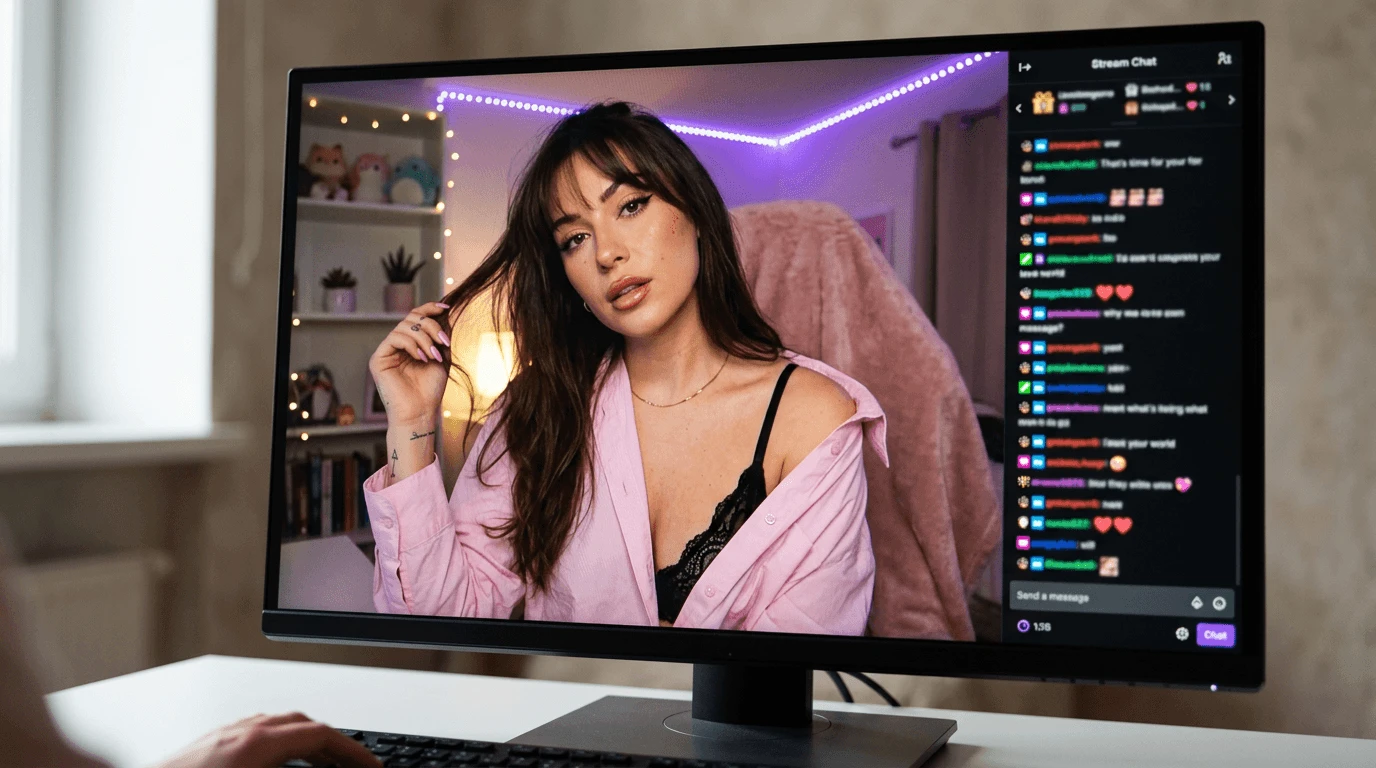
Then there is simple physics. Speech is monophonic. One voice occupies the channel, and the moment a second one arrives, both become noise. Text is polyphonic. Forty people can type in the same second and every line still arrives intact, stacked, readable, each one carrying a name.
This is the quiet genius of a public room on sexy cams. The model speaks, because she is the one performance the channel can hold, and the crowd writes, because writing is the only way a crowd can speak at all without turning into a crowd noise. Open forty microphones into that room and you would not get a more intimate experience, you would get a stadium. The asymmetry is not a limitation of webcam sex. It is the design that lets it work.
Your voice is a face
A voice is biometric. It carries your age, your region, the city you grew up in, a cold you are getting over, and, most inconveniently, the fact that it is recognisably yours. People who would never put their face on camera happily speak without thinking, which is strange, because a voice is identifiable in a way a typed line simply is not.
Text gives you something closer to a neutral mask, and here is the interesting part: it does not flatten you. Phrasing, timing, the way you punctuate, the jokes you choose and the ones you let pass all survive the transfer. Regulars are recognised by their writing long before anyone hears them. You keep the personality and leave the fingerprint behind.
A line of text weighs almost nothing
Voice is expensive. It needs bandwidth in both directions, it needs the connection to stay clean for the whole duration of the sentence, and it punishes any delay with that awkward half second where two people start talking and both stop. A line of text weighs a few hundred bytes. It survives a weak signal on a train, a hotel network, a phone with one bar.
It also persists. Speech evaporates the instant it is made. A written line sits on screen, can be read twice, can be scrolled back to an hour later when she wants to remember who asked what. On busy live sexcams, that durability is worth more than fidelity. The message that is still there is the message that gets answered.
Typing asks very little of you
There is a last, practical truth that everyone understands and nobody says plainly. Speaking requires composure. It requires a steady breath, a working throat, and a body sitting still enough to produce a sentence that sounds like one. A keyboard requires none of that. It works at a whisper, at an angle, with half your attention, in the dark, in a state where speech would be frankly ridiculous.
Platforms that have tried to push voice as an upgrade keep rediscovering this. The feature works beautifully in demonstrations and then sits unused, because the people who actually use it are solving a problem they do not have. Text is not the lesser version of talking. In a room where one person is live and many are present, it is the only input that does everything at once: silent, parallel, anonymous, cheap, permanent and effortless.
Tonight, somewhere on Xcams, someone is typing six words with one thumb and getting a better answer than a perfectly recorded sentence would have earned. The keyboard is still winning, and it has very good reasons.